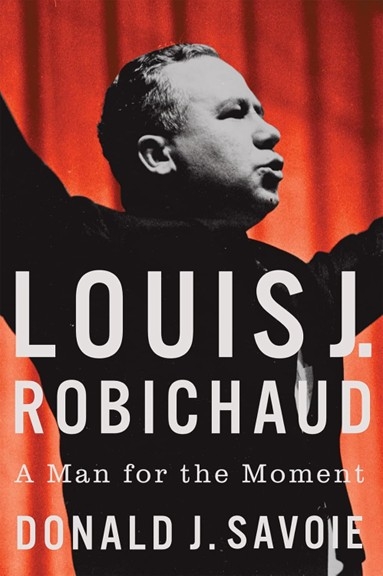
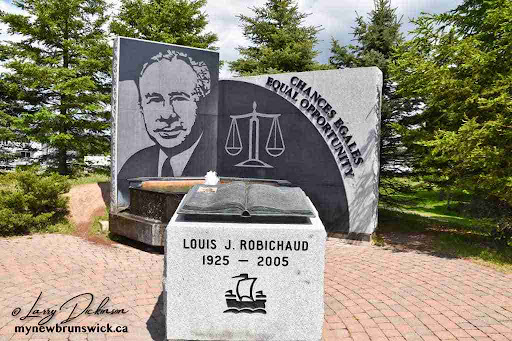
Prolific New Brunswick author, Donald J. Savoie, takes a fresh look at New Brunswick’s most consequential Premier, and almost certainly the province’s most courageous one, in his new book Louis J. Robichaud - A Man for the Moment (McGill-Queen’s University Press, 2026 - click title for Amazon link).
New Brunswick prior to Robichaud’s time
As Professor Savoie explains, New Brunswick before 1960 was an impoverished backwater with massive income disparities between the cities (such as they were) and the rural areas.
The province’s 15 counties operated independently of one another and had significant responsibilities for basic societal needs, such as health, education, and welfare, but had few resources to fulfill those mandates. Some counties often teetered on the verge of bankruptcy.
Add to this that French-speaking Acadians, who were treated as second-class citizens at best, populated many of those poor rural areas. Few had the opportunity to attend school beyond Grade 8, particularly in their native (and only) language, and those who did usually had to pay out of pocket. English-speaking families’ experiences were far more favourable.
Politically, New Brunswick was generally as steady-as-you-go-conservative – and Conservative – as could be. The English-speaking men in government (and they were all men) had little incentive or desire to rock the boat, and they certainly had no intention of letting Acadians even get on the boat.
Acadians had their place in society’s lower echelons, and that’s exactly where most English-speakers felt they should stay.
No one expected Robichaud to win in 1960
Against this backdrop, no one expected New Brunswick to elect a fiery Acadian orator named Louis J. Robichaud from beleaguered Kent County in 1960.
Even less so did anyone expect that Robichaud would drag the province, in the face of often virulent and bigoted opposition, into a series of reforms that would eventually make New Brunswick a fairer, better-governed, more modern, and more economically sustainable place (author’s note: we should revisit some of the property tax reforms from that era, in my opinion).
Acknowledging that Louis Robichaud was a friend and fellow Kent County Acadian, Professor Savoie makes no bones about his bias toward the late former Premier and what he accomplished during his 10 years in office. The book is rife with admiration for Robichaud’s rare combination of vision, courage, and fundamental personal integrity and decency of the type we rarely encounter in public life these days.
The author makes it clear that, while Robichaud certainly wanted to improve the lives of his fellow Acadians, he did not make this his main agenda. He was far more focused on mitigating income disparities across the province, thereby improving the lives of Acadians and non-Acadians alike.
New Brunswick simply could not fulfill its potential without everyone, no matter where they lived or what language they spoke, having a relatively equal opportunity to develop and contribute.
Robichaud establishes what became known as the Byrne Commission
To this end, Robichaud directed Edward G. Byrne, lawyer and former mayor of Bathurst, to establish the Royal Commission of Finance and Municipal Taxation early in his first mandate.
As was Louis Robichaud’s way, he gave Byrne whatever leeway the latter thought necessary in finding ways to redistribute income so that the financing and delivery of services were relatively similar throughout the province.
This became known as the Equal Opportunity Program, and to say that it upended the province’s existing economic and social establishment would be a massive understatement.
As a result, Robichaud faced everything from obscene phone calls to his kids being bullied at school to death threats. Yet the Premier persevered not only through this but also through the passage of the province’s controversial Official Languages Act later in his tenure. He displayed unwavering and unimaginable courage and commitment to his vision of a better New Brunswick.
It’s no wonder that subsequent governments dared not undo what Louis J. Robichaud had done.
Author needs to provide context for some references
The book misses the mark slightly in a couple of areas. One is where it mentions a situation or person in passing but does not explain enough to help a reader, especially a non-New Brunswicker or someone reading about Robichaud’s era for the first time, understand where the reference might fit into the story.
An example is the author's first mention of the former mayor of Moncton, Leonard Jones. The reader would benefit from knowing right at the outset that Jones was an odious figure, infamous for his official anti-French stance while in office (English only in Council meetings, no bilingual street signs, etc.). Instead, Jones is described in more detail only later in the book.
The other omission of note was the author's mention of Robichaud’s suggestion to then federal Minister Jean Chrétien that New Brunswick should have a second national park and that it should be in an Acadian region. As an Acadian, Professor Savoie is undoubtedly aware of how disastrously the government implemented this in terms of expropriating the people who lived on the land that became Kouchibouguac National Park.
In that the repercussions of this have continued to this day (I know, because I live right near there), this warranted a paragraph of context, at the very least.
Last chapter doesn’t do much to enhance the author's story of Louis J. Robichaud
Finally, I struggled with the way the last chapter was presented. It talks about “whether we could see another Louis Robichaud meet an important moment of the kind he met.” In doing so, the chapter takes the book in a different direction from its stated purpose.
It borders on the curmudgeonly, repeatedly stating that the current era is unlikely to produce a public figure of Robichaud’s stature because everyone in this era is “self-interested” in a way Robichaud never was.
Perhaps, but the chapter, as it is structured, does little to add to his take on the story of Louis J. Robichaud, which he already tells very well in all the preceding chapters.
Notwithstanding the last chapter, the book doesn’t try to be anything it is not. Professor Savoie makes it clear that other authors have written more dispassionate biographies of Robichaud, noting that he has relied on these to tell his own story.
And if you read this book with the author’s personal bias in mind, you will get a particularly favourable picture of New Brunswick’s first elected Acadian Premier, but not one that is any less true because of it.