
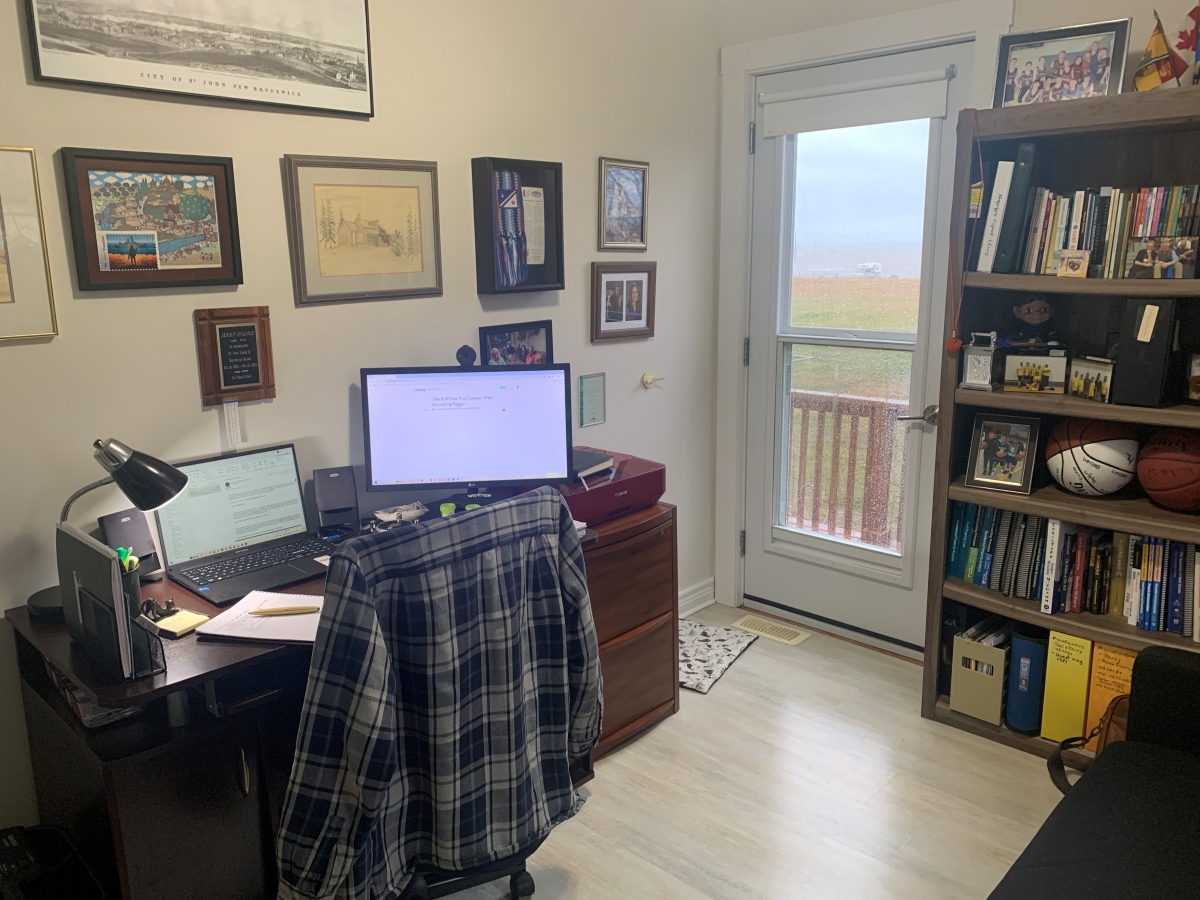
But “sacred space” isn’t necessarily what you think it is
Not every sacred space includes an altar
Or a tabernacle with chalice.
Or pews, or prayer rugs.
Sacred spaces may well include books, writing desks, and special pens and notebooks. Maybe basketball hoops or hockey equipment. Could be a music studio. There might be bread and wine involved, but that may just as easily be at your cabin in the woods or in your kitchen as at a majestic cathedral.
It all depends on where you choose to connect with something bigger than yourself. For some, that “something bigger” is a specific definition of God; for others, it may be far less defined, but no less profound and meaningful.
An unexpected sacred space
Many years ago, when we used to attend church, our ministers (a husband-and-wife team) decided to move on, and it took a while for the congregation to find a new one. In the meantime, we had a supply minister who wanted to move the services to Sunday evenings. I told him that this wouldn’t work for me, as that was my recreational hockey team’s home ice time.
To which he replied, “What’s more important — church or hockey?” Spoiler alert: hockey won out, but not for the reasons you might think. The secular did not win out over the sacred in this case — quite the contrary, in fact.
It was because our dressing room was no less a sacred space for me than was the sanctuary of our church building. The dressing room was where lifetime friendships were forged, and spouses and children would come in after the games for family fellowship. That sacred space wasn’t institutional, but it was real.
I don’t mean to downplay the wonderful relationships I had with most people in our church (excepting, perhaps, with that particular minister). But in tending to friendships and fellowship outside of church, I was indeed connecting to something bigger and meaningful to me, even if it was in a smelly old hockey dressing room.
Sacred spaces at home
My wife, Michele, and I spoke just the other day about sacred spaces in our own house and yard.
My sacred spaces
For me, my study is a sacred space. Here, I grow by discerning, ordering, and sharing my thoughts through my writing, as well as by reading and thinking about what others have to say. Then, there are the books and memorabilia that surround me, reminding me of the joy I’ve drawn from people and experiences in my past. Other books in my study await my attention.
In this room, I feel connected, both broadly and deeply — to others throughout the world and to past versions of myself and others throughout time. This fills my soul.
Michele’s sacred spaces
For Michele, the kitchen is a sacred space. Everything she does there, from preparing Ukrainian dishes as a way of honouring my heritage, to trying healthy (and interesting) new things that just might extend our stay on this earth a day or two, is love personified.
It’s also the place where we light a candle at supper and sometimes crack a bottle of wine while we talk about everything under the sun. The kitchen is where we celebrate our marriage, not just on special days, but every day, by breaking bread (or some low-calorie alternative — sigh) together. It’s where we nourish our relationship, both literally and figuratively.
The greenhouse in our yard is also one of Michele’s sacred spaces. I don’t know that she’s ever happier than she is when inside that 8′ x 10′ wood and thick-mil plastic refuge, where she dodges fair-sized spiders (they give her permission to be there, rather than the other way around, it seems) and buries her hands in rich, black dirt in anticipation of another growing season.
And the garden is but an extension of that. The type of happiness she experiences when engaged with the soil is sacred all by itself.
Other sacred spaces throughout our lives
On sea and on land
One is my fishing chair, from which I haul in ocean creatures that give their lives so that we may eat. Another was my daughter’s bedroom when she was a newborn, with all the bits and pieces we needed as we excitedly launched that precious life (the room became decidedly more unholy as she got older).
There was also the music studio our next-door neighbours built in their garage. We passed many a Friday night there playing music, laying down some tracks, and imbibing the odd refreshment. There was a two-year period during which that re-purposed garage was not only sacred, but magical, with memories enough to last a lifetime.
My boat used to be a sacred space, too. It was a place where I could lose myself, whether while tinkering with it in the yard or cruising on the ocean out back, at least during the times it worked. Which was, shall we say, intermittently. The boat still makes me want to express some decidedly non-sacred terms.
And in a very special gym
Then there’s the gym at the junior high school in central Alberta, where I used to coach basketball, thereby giving young athletes the tools they would need both on and off the court as they progressed to the next stage of their lives. Tools like embracing process more than outcome and showing respect for opponents, referees, and each other.
The fact that some still stay in touch with me tells me that we were indeed in communion with “something bigger” when we filled the gym with swishes, shoe squeaks, and plaintive shouts of “Not another lap, Coach!”
I was in awe every time I entered that gym. It was a sacred space where, for six years, I got to do one of the things I felt I was put on this earth to do. And there’s nothing “bigger” than living in the blessed overlap between what you choose to do and who you are meant to be.
Sacred spaces don’t have to be institutional
We all have sacred spaces, even if we don’t always realize it, because we’re conditioned to think that “sacred” equals “institutional.” Nothing could be further from the truth. Sacred spaces aren’t sacred because someone says so — they’re sacred because of what we do there and how that connects us to more than just ourselves.
These spaces aren’t necessarily found in chapels or buildings, although they certainly can be. But they can also be found in the smallest of rooms in our homes, the densest of forests, or the sandiest of beaches (but rarely in a boat that won’t start, or a teenager’s bedroom).
You don’t need an altar, a tabernacle, a pew, or a prayer rug for your space to be sacred.
Although nothing says you can’t include those, too.
On dying & grief series
The Call of Home series
More memoir
The second generation: Life as a child of Ukrainian immigrants
Growing up working class, I wanted to be something else
Our house is not a “Very, very fine house”
Competition: Its unexpected value at every stage of life
Major Work: We were “Sputnik’s Children” – until “streaming” became a bad word
Fishing for the ‘Big One’? Forget it – any size catch will do
What you lose when you ignore ceremony and ritual
The value of reconnecting in our “last quarter”
Divorce 25 years on: Our daughter is still reaping the benefits
Letters: The wondrous time capsule I found on my bookcase
Navigating Friendship in My “Last Quarter”
Boating in retirement: The pitfalls of becoming “one” with the sea
The “Mongoose System” recipe for life: Take chances, make mistakes, and have fun
The truth about regret: You are what the results say you are
Cultural cross-currents: What I now know in moving to Canada’s only bilingual province
Happy ending? My family dysfunction would make For better TV
One uncomfortable truth my 18-year-old self needed to hear
Settling for less: How many of us end up doing what we truly love?
Generosity of spirit: The key ingredient to a successful marriage
November 1980: The day I struck a blow for Canada
Turning sixty-five has been a kick in the teeth in a way I never would have expected
Pachelbel, the CBC, and the liberal arts: A surprising connection