
We crave the structure, meaning, and community that marking passages and occasions through ceremony and ritual gives us
The old rituals on Ukrainian Christmas Eve
There it was, a chunky four-foot trail of the Ukrainian honey-and-grain dish known as kutia, hanging on to the ceiling for all it was worth.
This was a good sign, as the more that stuck, the more good fortune there would be in the coming year, according to ancient Ukrainian Christmas Eve tradition. Our daughter, Jillian, took great joy in being the designated kutia flinger, and her efforts that particular year pointed to a promising time ahead.
When we lived in Alberta, celebrating Ukrainian Christmas Eve as per the Julian calendar on (or close to, as a matter of guest convenience) January 6 was a deeply meaningful event in our household, one that our friends would automatically block off in their calendars.
Many of these friends would also team up with my wife, Michele, to help prepare the 12 traditional meatless dishes, including kutia and pyrohy (dumplings with various fillings), that make up the Christmas Eve feast. They held more than one wine-infused pyrohy-making bee prior to the big day, usually at the house of someone who had a much bigger kitchen than we did.
It was all part of a grand annual celebration of friendship, culture, and tradition.
We added our own rituals
The Christmas Eve event itself was also a vital part of our two-household post-divorce family life, as our daughter would spend “English” Christmas with her mother and other relatives. Then, she, her mother, and her mother’s partner would come spend Ukrainian Christmas with us. Everyone was happy with the arrangement.
We could always count on the celebration and the rituals it embodied, such as the flinging of the kutia, placing straw under the table, and leaving one empty setting for the departed, to bring our whole circle together, including friends from disparate parts of our lives, once a year.
This was a glue that bonded us all together, Ukrainian and non-Ukrainian alike, and connected those of us who are Ukrainian to an ancient culture and a community far beyond the walls of our house. It was incredible.
And, yes, there was vodka. Vodka’s not a traditional ritual, but it certainly was one of ours. Na zdorov’ia! Khrystos rodyvsia!
Every culture has ceremonies and rituals
Jewish culture includes bar and bat mitzvahs to mark the transition from childhood to adulthood. Indigenous communities throughout North America adhere to traditions such as sun dances, powwows, sweat lodges, and potlatches, and make tobacco offerings when requesting guidance and knowledge from an elder or knowledge keeper, among many other things.
Muslims are required to pray at least five times per day, while Sikhs hold a turban ceremony that serves as a rite of passage for children between the ages of 11 and 16. The list of examples goes on. And there’s archaeological evidence from burial sites that ceremony and ritual have been part of human existence for tens of thousands of years.
Clearly, we crave some sort of structure in our lives that brings us together and allows us to find meaning in what might otherwise seem meaningless and arbitrary. Thus it has ever been.
What happens when we deny ceremony and rituals?
Sadly, we needn’t look very far to find the answer, as Canada’s indigenous peoples can all too readily attest.
Canadian governments, from very early on, thought that the best way to build a nation was to “civilize” the land’s original inhabitants by assimilating them into white Euro-Canadian culture (I’m being kind in my wording here).
One of the ways they thought to do this was through the Indian residential school system, wherein children were taken far away from their families and communities from a very early age (to “have the Indian beaten out of them,” as many would later say). No chance to learn indigenous culture and mores while dangling from a parent’s or elder’s knee, and no opportunity for the very village that wanted to raise them to do so.
Another was by making indigenous ceremonies illegal, as they were from 1884 to 1951. The long-term effects of these policies are still felt today, as residential schools and the ban on ceremonies cut off the passing down of cultural practices and traditional storytelling.
As a result, indigenous peoples lost their sense of identity and often turned to destructive behaviours to fill the void. An entire culture was kneecapped for decades to come, and it’s only today that a modicum of healing has begun, largely by reconnecting with the very ceremony that was denied.
As indigenous elder, scholar, and knowledge keeper, Wilfred Buck, says, everything comes through ceremony: belonging, purpose, personal transformation, and cultural revival.
And hope.
As long as there’s indigenous ceremony, there’s always hope for reconciliation with our fellow treaty people.
Ceremony and ritual mostly ignored in secular life
And yet we in the so-called mainstream pay little mind to ceremony and ritual in our daily lives. We lack the things that ground us and bind us together. We live fragmented lives that deny us a sense of shared experience or a marking of life’s milestones.
This certainly isn’t true for everyone, of course. Many of us belong to religions or cultures in which ceremony and ritual play an important part — a walk down the street in any city will quickly tell you that, with turbans and hijabs in abundance. Or a visit to a Ukrainian Orthodox or a Ukrainian Catholic church, where the mass still displays ancient Byzantine-rite rituals.
But this isn’t true for the many (most?) who live a secular life, especially here in Canada, where the closest thing to ritual is stopping at Tim Hortons on the way to yet another Sunday morning hockey game, and the closest thing to ceremony is restaurant servers singing “Happy Birthday” as they serve you a piece of ice cream cake with a single sparkler in it.
And we are poorer for it. Nothing to mark passage, nothing to ground us, nothing to connect us to something bigger (whatever that may be), and nothing to bind us together. We might not even realize that we are missing this in our lives, but we are.
Just ask our indigenous neighbours.
We all want — need — something to help us make sense of the chaos, which is exactly what ceremony and ritual do. Yet we continue to ignore these things.
Ukrainian Christmas Eve rituals by the wayside now (mostly)
Sadly, Michele and I don’t celebrate the traditional Ukrainian Christmas Eve here in New Brunswick the way we did in Alberta. We don’t have the same tightly-knit group of friends here, and our extended family has other priorities and tastes.
We have numerous Ukrainian friends here in the wake of the Russian invasion of Ukraine, but they don’t celebrate the old-calendar Christmas Eve either. In an effort to orient themselves increasingly towards the West (and away from Russia, which still celebrates on January 6), they now celebrate on December 24–25.
So we have found ourselves needing to evolve. Michele and I (and our daughter and son-in-law, the one year they were here) have our own little January 6 celebration.
This is as much to remind ourselves of our own family history as to connect to an anachronistic version of Ukrainian culture that still exists among many families in Canada, if not in mainstream Ukraine.
Small daily rituals can make a big difference
Michele and I also try to find other ways to include ceremony and ritual in our lives. We’re not churchgoers, but we do occasionally attend Ukrainian church services about an hour and a half from home, as I feel the need to be around those rituals and to hear the language from time to time.
Michele, for her part, feels the need to continue starring in the role of “best wife ever” by joining me when I go.
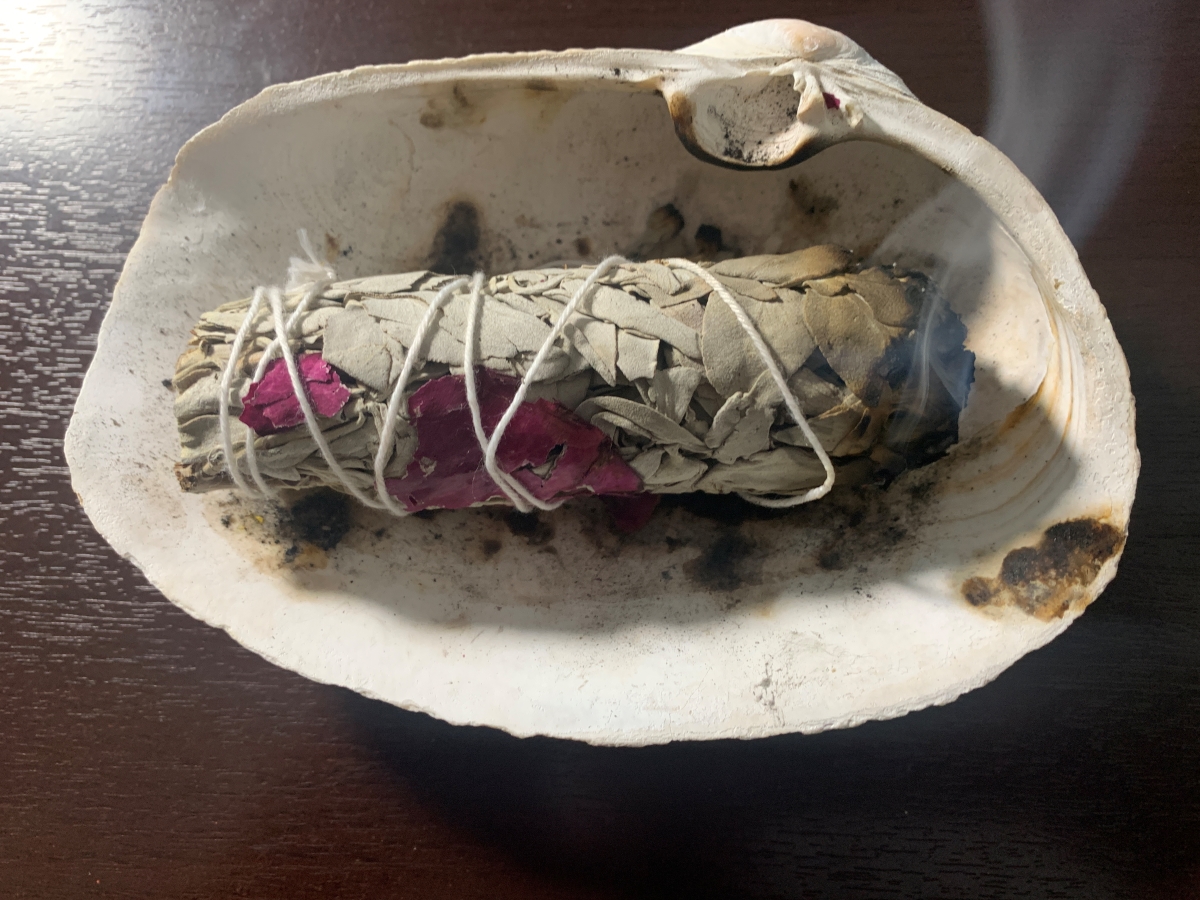
On a smaller scale, we say a little secular prayer of gratitude before each meal. I also light sage and listen to a short piece of calming music just before I begin writing, while Michele has her own daily grounding exercises.
When I catch a fish and am about to kill it, I make a point of consciously acknowledging that it’s giving its life so that we can eat it. It’s a small thing that someone walking by along the shore wouldn’t even notice, but it’s something that connects me to the animal, the ocean, and the universe.
A small thing becomes part of a big thing.
We add structure and meaning to our days when we engage in those little practices.
* * * * * * *
Ceremony and ritual don’t have to be fancy or elaborate. All that’s required is that we undertake what we do in a spirit of reverence, gratitude, respect, and connection.
And the fact that we, as a society, seem to be missing those very things wherever we turn should tell us everything we need to know about the cost of ignoring ceremony and ritual in our lives.
Oh, and the kutia on the ceiling? We never did manage to remove it entirely before we moved from that particular house.

On dying & grief series
The Call of Home series
More memoir
The second generation: Life as a child of Ukrainian immigrants
Growing up working class, I wanted to be something else
Our house is not a “Very, very fine house”
Competition: Its unexpected value at every stage of life
Sacred space: This is where you connect with something bigger
Major Work: We were “Sputnik’s Children” – until “streaming” became a bad word
Fishing for the ‘Big One’? Forget it – any size catch will do
The value of reconnecting in our “last quarter”
Divorce 25 years on: Our daughter is still reaping the benefits
Letters: The wondrous time capsule I found on my bookcase
Navigating Friendship in My “Last Quarter”
Boating in retirement: The pitfalls of becoming “one” with the sea
The “Mongoose System” recipe for life: Take chances, make mistakes, and have fun
The truth about regret: You are what the results say you are
Cultural cross-currents: What I now know in moving to Canada’s only bilingual province
Happy ending? My family dysfunction would make For better TV
One uncomfortable truth my 18-year-old self needed to hear
Settling for less: How many of us end up doing what we truly love?
Generosity of spirit: The key ingredient to a successful marriage
November 1980: The day I struck a blow for Canada
Turning sixty-five has been a kick in the teeth in a way I never would have expected
Pachelbel, the CBC, and the liberal arts: A surprising connection