
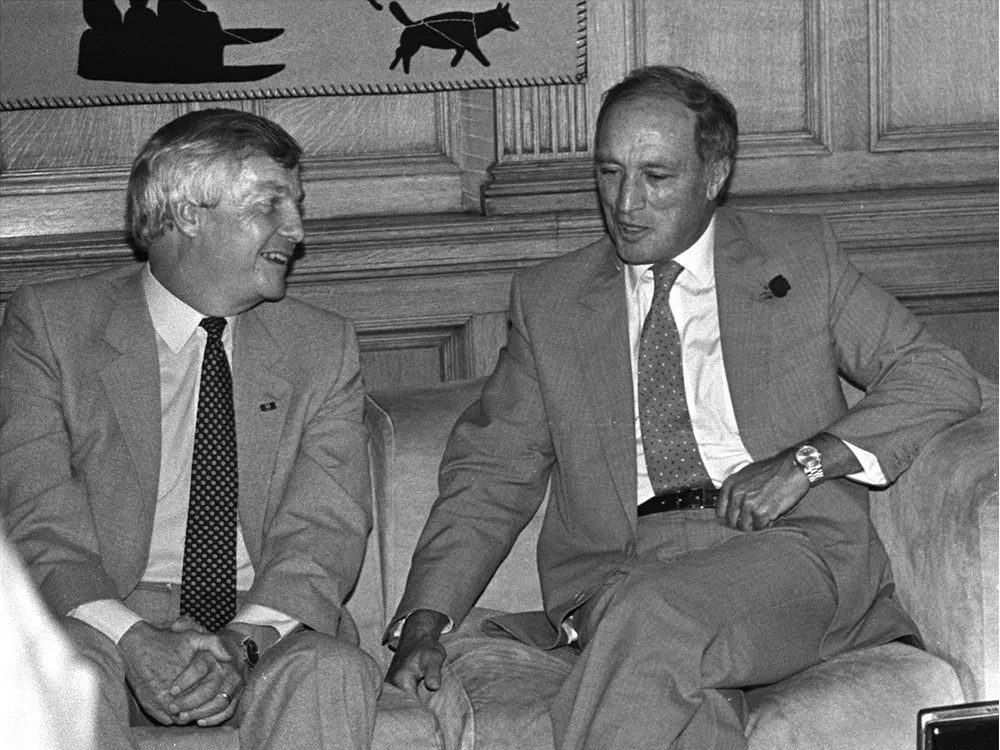
This is a post from a blog I did back in 2012 while I was living in Alberta. Peter Lougheed has been gone for over 11 years, but his legacy – one that politicians would do well to emulate today – still resonates for me.
I wasn’t always a supporter of the late former Alberta Premier Peter Lougheed, who died this past week (September 13, 2012 – J.I.) at 84. I moved to Alberta in 1978 and didn’t have the same basis of comparison that other Albertans did, particularly those who’d lived through at least part of the Social Credit years and who could therefore appreciate the contrast with the past.
In retrospect, I think that, had I grown up here, I would have been like many other Albertans – an ardent supporter of Mr. Lougheed and the change he represented in 1971.
But I didn’t grow up in Alberta. For many of the same reasons that journalist (now Senator – J.I.) Paula Simons gives in her outstanding essay, “Peter Lougheed: Arthur, Merlin and the dream of Camelot“, I had misgivings about the amount of power a premier could wield in a Legislature that had barely any opposition and about some of the anti-Canadian vitriol that Mr. Lougheed’s principled and tenacious defence of provincial sovereignty engendered among certain segments of the population.
He always considered himself a Canadian first but that didn’t stop others from taking Mr. Lougheed’s position that Canada was a “compact” of provinces and twisting it to accommodate their own separatist (and often bigoted) agenda (I recall one editorial cartoon at the time, which had a caricature of a Frankenstein monster with the words “Western separatism” scrawled on him chasing Mr. Lougheed and yelling “Dada!”).
I’ll admit, too, that I (perhaps naively) as a young University of Alberta student preferred a more centralized version of Confederation than Mr. Lougheed and many people in Alberta did at the time (although I’ll argue to the death that Canada was not a “compact” of provinces – otherwise, the Fathers of Confederation would have given the residual powers to the provinces, which they did not).
I’m less inclined toward that these days, recognizing that the absolute preponderance of population in Ontario and Quebec required someone exactly like Mr. Lougheed to create a sense of counterbalance and fairness across our country.
He was most certainly the right person in the right place at the right time, and I, as a Canadian, have grown over time to appreciate his contribution, not just to Alberta, but to Canada as a whole. My life as a Canadian and an Albertan is better because of Mr. Lougheed’s vision and tenacity.
Philosophical disagreements aside, my personal respect for Peter Lougheed was cemented a long time ago, based on two encounters with him – one direct and one indirect. As a University of Alberta student, I worked for campus radio station CJSR in 1979-80. Among other things, I covered the Legislature, which meant that I had a tape recorder, and I wasn’t afraid to use it. Of course, that didn’t mean I always knew how and when to use it properly.
A CBC-TV reporter once had Premier Lougheed lined up for a short, exclusive interview. Somehow, I wormed my way into the scene, pushed my microphone toward Mr. Lougheed, and proceeded to ask him a question about the “compact” theory of Confederation.
Without missing a beat, he graciously and patiently answered, as if I had every right to be there, which I clearly did not (the CBC-TV reporter was pretty gracious, too, come to think of it). It was a small thing that I’m sure he never would have remembered, but it certainly had an impact on me.
The other encounter with Mr. Lougheed was from a distance. It was the celebration at the Legislature of Alberta’s 75th Anniversary in 1980, which included both Premier Lougheed and Prime Minister Pierre Trudeau. I obviously followed politics closely and was very aware of the seeming public animosity between them but, when I watched them on stage, I saw these two supposed political foes sitting beside each other, chatting amiably.
I realized at that very moment that political disagreements didn’t have to be personal and that there was mutual respect between these two men. In fact, many interviews by both men I heard and read over the subsequent years bore that out.
What I learned from Mr. Lougheed and Mr. Trudeau at that very moment has stayed with me ever since and makes me decry all the more the lack of class, civility, and respect that pervades politics in our province (Alberta – J.I.)and our country today.
Mr. Lougheed proved every single day during his time in office and beyond that political discourse just doesn’t have to be that way.
I’ll leave it to others to describe Mr. Lougheed’s broader political legacy, but I’ll certainly not forget the graciousness and fundamental decency that he exemplified for me on those two occasions. This is a man whom Alberta politicians today should strive to emulate but most, sadly, do not. He was a giant in more ways than a young university student in the early 1980s, who grew up elsewhere, could possibly realize, but in ways that have endured.
I’ll honour him in my own way, by striving never to lose the lesson.
On dying & grief series
The Call of Home series
More memoir
The second generation: Life as a child of Ukrainian immigrants
Growing up working class, I wanted to be something else
Our house is not a “Very, very fine house”
Competition: Its unexpected value at every stage of life
Sacred space: This is where you connect with something bigger
Major Work: We were “Sputnik’s Children” – until “streaming” became a bad word
Fishing for the ‘Big One’? Forget it – any size catch will do
What you lose when you ignore ceremony and ritual
The value of reconnecting in our “last quarter”
Divorce 25 years on: Our daughter is still reaping the benefits
Letters: The wondrous time capsule I found on my bookcase
Navigating Friendship in My “Last Quarter”
Boating in retirement: The pitfalls of becoming “one” with the sea
The “Mongoose System” recipe for life: Take chances, make mistakes, and have fun
The truth about regret: You are what the results say you are
Cultural cross-currents: What I now know in moving to Canada’s only bilingual province
Happy ending? My family dysfunction would make For better TV
One uncomfortable truth my 18-year-old self needed to hear
Settling for less: How many of us end up doing what we truly love?
Generosity of spirit: The key ingredient to a successful marriage
November 1980: The day I struck a blow for Canada
Turning sixty-five has been a kick in the teeth in a way I never would have expected
Pachelbel, the CBC, and the liberal arts: A surprising connection