
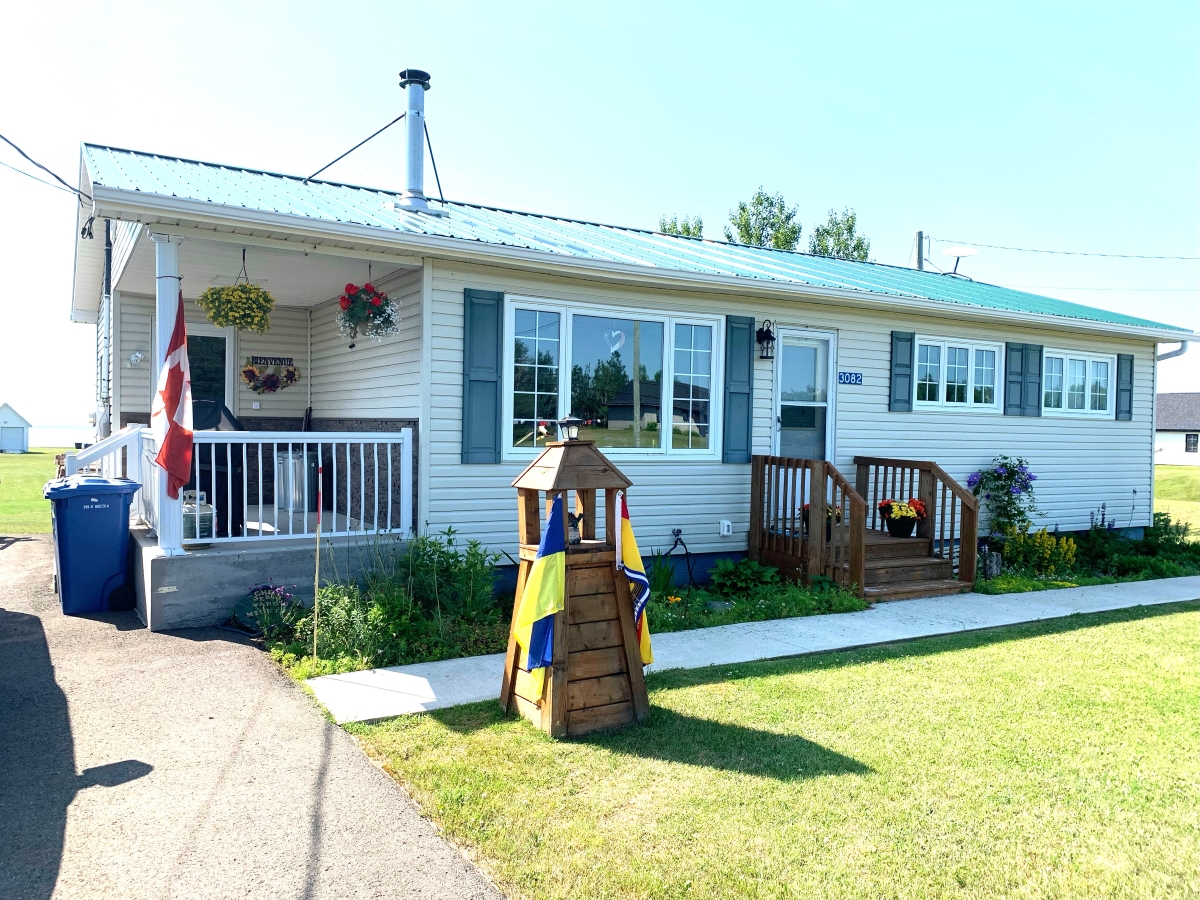
But this house is the best home I could ever imagine
…back to the idle farm with its pink roses — “survivors,” the poet will call them: “I always think of somebody setting out the plant a hundred years ago — perhaps a young bride who has been dead a half a century or more — and the bush keeps on blossoming.”
Gregory M. Cook, quoting the late poet, Alden Nowlan, in One Heart, One Way
The house continues to settle
Our house sucks.
Oh, sure, in the photo above, it looks like it could be the “very, very fine house” that Crosby, Stills, Nash & Young sang about in “Our House” in 1970. But don’t let that fool you — the structure has more faults and flaws than your average contractor (or even an above-average one like ours) could document in a day.
All you have to do is watch the water pool at the foot of a basement wall during a rainstorm from the southeast, or feel the creeping cold from an outside-wall electrical outlet in wintertime. Or spot yet another hairline crack in the main bedroom — a crack you swear wasn’t there a week ago.
You’d think that, after more than 60 years, the house would be done settling, but the law of entropy, which states that everything must deteriorate or become disorganized over time, continues to make its presence felt. We should expect a lot more settling yet, it appears.
And this is just the visible stuff — I’d hate to think what is, or isn’t, inside the walls.
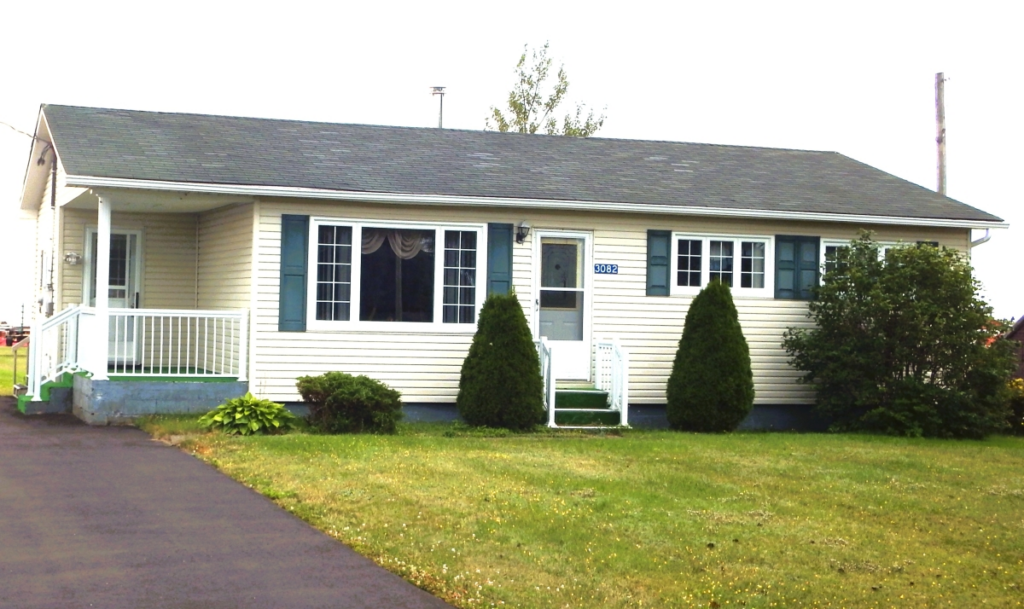
House and yard left a lot to be desired at first glance
Both the house and yard were in a sorry state when we first looked at the property during a family visit to the East Coast in the summer of 2014.
The roof was missing shingles, and both porches were covered with that ugly green indoor-outdoor carpeting that makes shovelling snow even more difficult than it already is. And there were random shrubs all around the house and yard, looking very much like they grew wherever the wind had dropped the seeds.
However they got there, they certainly hadn’t been tended for a long time.
Inside the house, the tub surround was cracked, the basement included an illegal wood stove and a couple of rickety, half-broken workbenches, and the plumbing and electrical systems looked like they’d been installed by a do-it-yourselfer with just enough knowledge to glue and screw things together, but not enough to do it correctly.
Which, as we would learn, turned out to be the case.
Overall, the house and yard exuded sadness and neglect, unsurprising since we were purchasing it from an estate. The widow living there had died a few months earlier, and her husband 10 years before that. They were the original owners, having built the house in the early 1960s.
What we learned about the house and yard, and what we still wondered about
As we got to know the neighbours, we learned that the husband had leaned heavily on the bottle, at least in his later years. The widow, who was a well-respected schoolteacher in her day, was left with a house and yard that required a great deal of effort to keep up over the 10 years she was alone there.
As my wife and I would readily attest, this couldn’t have been easy, as we know all too well that keeping up a small-acreage property ideally requires two relatively healthy people, and sometimes great neighbours, besides.
All this explained why we had little sense of anything joyful when we first laid eyes on the place.
Where were the “survivors” — the blossoms that a young bride may have planted 60 years ago?
Did they whither a little bit every year after the husband died and the widow lost the desire to tend them? Or did she ever plant them at all?
Did the young couple share a vision of hope and promise when they built the house? Or did they just get on with what they had to do with what little they had, flowers being a frivolity?
Was it always like that, or did something change along the way?
Incremental efforts to beautify and house and yard
Immediately upon purchase, we fixed the house’s plumbing and electrical systems, which the home inspector said we should do sooner rather than later.
Then, both before we moved in ourselves in 2019 and afterward, we spent many more thousands on maintenance and improvements: central heat pump, metal roof, wood stove, new porches at both doors, large deck overlooking the ocean, baby barn (New Brunswick slang for storage shed), bathroom reno, additional insulation in the attic and basement, and regular painting.
The house also required significant repairs after an ice storm in January 2017, when power was out for eight days while we were still in Alberta. Our renters had understandably relocated elsewhere for the duration of the outage (we had no generator at that time), so the house was left to the mercy of the elements.
We almost lost it completely then — thank heavens for moderate temperatures over those eight days and a local property manager and contractor we could rely on.
As for the yard, we’ve pulled out bushes and shrubs that were either overgrown or made no sense where they were. We’ve planted flowerbeds that are resplendent in the summer and built raised garden beds to grow at least some of our own food.
We’ve cut down some trees and shrubs, and planted new ones, including apple and butternut, as well as bushes that turn so red in the fall, you’d think they were on fire.
My wife also started some grapevines that have produced quite nicely over the past couple of years, although the region’s vintners shouldn’t quake in their boots quite yet.
Every year, we’ve added something to make the house and yard as attractive and resilient as possible, all of which reflects our joy in living here, despite the house’s ongoing entropic suckage.
House repairs – a transitory problem at worst
The other day, after a bout of grumbling about how much I’d have to include in our 2026 budget for yet another round of significant house repairs, I came across the quote at the beginning of this piece in a book I was reading about Canadian poet Alden Nowlan (1933–1983).
I felt like someone had grabbed me by the shoulders and given me a shake, telling me to stop feeling sorry for myself about troubles that are, at worst, transitory.
There was something about seeing our lives from a person’s perspective 50 years from now that made me think about our place and situation differently.
“…and the bush keeps on blossoming.”
Whether the house is here 50 years from now or not, what we’ve done here in the spirit of love will remain for the generations that follow. People not even born yet will get to sample the butternuts and the apples, and stand in awe of the impossibly red bush in our front yard every fall.
Perhaps they’ll also marvel at the perennials my wife planted in the front beds, which flower at different times throughout the summer. Fifty years after we’re gone and forgotten, another poet may well come along and wonder how long those very plants have been blossoming in such splendour.
The answer? From the time that we moved in, when love and joy took root here. From the time we made this the best home I could ever imagine, even if it’s not the best house.
Celebrating a house and yard where love lives
In the future, new people may come here with their own hopes and dreams and a desire to live in a house that overlooks the ocean, as we did. But they will know from what we leave behind that love lived here and that someone long ago built their lives in celebration of that.
And in the hope that future generations will plant yet more bushes that keep on blossoming for years to come.
On dying & grief series
The Call of Home series
More memoir
The second generation: Life as a child of Ukrainian immigrants
Growing up working class, I wanted to be something else
Competition: Its unexpected value at every stage of life
Sacred space: This is where you connect with something bigger
Major Work: We were “Sputnik’s Children” – until “streaming” became a bad word
Fishing for the ‘Big One’? Forget it – any size catch will do
What you lose when you ignore ceremony and ritual
The value of reconnecting in our “last quarter”
Divorce 25 years on: Our daughter is still reaping the benefits
Letters: The wondrous time capsule I found on my bookcase
Navigating Friendship in My “Last Quarter”
Boating in retirement: The pitfalls of becoming “one” with the sea
The “Mongoose System” recipe for life: Take chances, make mistakes, and have fun
The truth about regret: You are what the results say you are
Cultural cross-currents: What I now know in moving to Canada’s only bilingual province
Happy ending? My family dysfunction would make For better TV
One uncomfortable truth my 18-year-old self needed to hear
Settling for less: How many of us end up doing what we truly love?
Generosity of spirit: The key ingredient to a successful marriage
November 1980: The day I struck a blow for Canada
Turning sixty-five has been a kick in the teeth in a way I never would have expected
Pachelbel, the CBC, and the liberal arts: A surprising connection