
Death was always my periphery when I was a child, but I never had reason to cry for anyone
“…we ought to muster the noble greed to enrich our inner world precisely with this loss and its significance and weight…The more deeply we are impacted by such loss and the more violently it shakes us, the more it is our task to reclaim as our possession in new, different, and definitive ways that which, by virtue of being lost, is now so hopelessly emphasized.”
R.M. Rilke, letter to Countess Margot Sizzo-Noris-Crouy (January 6, 1923), The Dark Interval: Letters on Loss, Grief, and Transformation
First experience of death
As a child, I often thought about death.
Not in a fearful or worrisome way (although I do recall terrifying dreams about unseen presences), but as a pure curiosity, especially about the rituals surrounding burial and grief. I certainly never experienced anyone close to me dying.
Like for many my age, the funeral for American President, John F. Kennedy, in November 1963 was one of my first conscious memories. Naturally, I didn’t understand the big picture at age 4 — I knew someone important had died, but I didn’t know exactly what it all meant.
But I did know that the funeral was a big, sombre deal, especially since it pre-empted cartoons on each of the two English-language TV stations we had at that time. Serious business.
Death closer to home
Closer to home, my family and I belonged to the first-generation Ukrainian Catholic community in Winnipeg, so it is unsurprising that I would encounter death and grief when we were called to mourn the passing of our fellow community members from time to time.
I was 9 or 10 when I attended my first funeral. It included the Ukrainian dirge, “Vichnaia pamiat” (“Eternal Memory”), being sung over and over, and there was no mistaking how funereal this melancholic, repetitive chant was. I would hear it many more times throughout my life.
As was customary, the funeral was open-casket. The man, who’d been a caretaker at our community hall, meant nothing to me, so I didn’t feel a sense of loss. But I was fascinated by the entire process, particularly the open casket, as this was the first time I’d seen death up close.
I remember sitting with a friend, just slightly older than I – a “cool” guy I kind of idolized, who cried once during the service — spontaneously, it seemed — and I really wasn’t sure what to make of that.
Did he really know the deceased that well? Perhaps they had interacted during the time we spent at the hall, participating in various community activities, and he genuinely felt a sense of loss.
Or did he cry because he felt that he should? Regardless, it seemed a bit “off” because I don’t recall sharing any overarching sadness in our conversation as we sat through the parts of the ceremony before that. I’m not sure, but that little bit of sudden emotion has stuck with me ever since because of how real, yet incongruent, it appeared to me at the time.
For a variety of reasons, I found my first encounter with death fascinating, but definitely not sad.
The complex interplay among death, ritual, and grief
The Ukrainian Catholic community observed numerous other forms of grief ritual, including a service and meal 40 days after someone’s death (a day on which it is said that the deceased’s soul finally departs the earthly realm) and a requirement throughout the year afterward that relatives not dance and continue to wear black.
These rituals are not observed as strictly today, but they were unbending at that time. In some ways, people adhering to these rituals meant that reminders of death and grief were often visibly present somewhere in the community. I took note.
As an aside, I remember my mother coaching me at that time on how to behave around someone who had suffered a loss and was grieving: don’t say anything that would remind them of the passing because it will make them sad.
I learned much later that this wasn’t necessarily the best thing to do, as memory is part of what keeps that person alive in the minds of those who remain, but I know my mother’s heart was in the right place. Even then, as she and I talked of these things, the complex interplay among death, ritual, and grief continued to fascinate me.
My friend’s childhood death leaves its mark
I attended my first Ukrainian Youth Association summer camp when I was 8 or 9. A fellow camper, same age as I, had lost his mother to cancer scant weeks prior. He would wake up at night screaming, obviously in deep pain.
My friend and I recently had an opportunity to re-acquaint ourselves, as we both now live in New Brunswick. He told me that his family had sheltered him from his mother in her last days, which denied him the opportunity to say good-bye in whatever form it would take for someone that age.
Sheltering children from death was the norm at the time, though, so those around him honestly thought they were doing the right thing. But had they been able to see into the future, they would have seen how he still relives and suffers through those stolen moments.
Closure often seems as elusive as ever for my friend even now, over 55 years later.
An unfortunate death with an interesting sidebar
Then, there was the first time I went to a funeral where someone had to bury their child — an adult child, but their child, nonetheless. I was 14 when the older brother of the fellow with whom I had attended my first funeral was killed. As I understood it (and recently confirmed), he died in some type of motorcycle-truck encounter at the side of the road outside of Calgary.
Apparently, he’d been involved with one of the local “motorcycle clubs,” so the attendees at the funeral mass included numerous members of that organization.
I’m sure I sat there wide-eyed, checking out these tough-looking, bearded, and mustachioed men, with colours proudly displayed, my naïve teenage self trying to understand the bigger picture that day.
I remember being jolted awake to the outside world a little, as the club members didn’t perform the Ukrainian Catholic church rituals, such as standing at certain times or crossing oneself, that were so familiar to me. In my sheltered little Ukrainian Catholic immigrant enclave, it had never even occurred to me that this was possible.
I was unfortunately too young and self-centred to be empathetic toward my friend and his family at the time and, although I knew the deceased in passing, he wasn’t someone I would miss. I shed no tears, but I sure found the funeral interesting.
Death on my periphery, where I hoped it would stay
Death and grief were thus always on the periphery of my pre-adult life, but no closer. Sure, there were letters from Ukraine (then the Ukrainian SSR) about relatives on my father’s side dying, such as my grandfather in 1966, my namesake uncle, who was killed by lightning in his own backyard in 1970, and my grandmother in 1972.
But I had never met these people, and the only reason they meant anything to me was that we all shared the same last name. (My mother’s parents in Hungary were — and continue to be — a mystery, although I knew that they had died well before I was born.)
The thought of my own parents’ death entered my brain from time to time, and I found it truly frightening, even into my early 20s. Unsurprisingly, I had no real context for how old they really were or what sorts of health issues could take them. I knew their chronological ages, but we don’t really understand ages and life stages until we’ve lived them ourselves.
They were both too quick to play the guilt-inducing “I die soon” card throughout their lives, so even though I knew that my mother was somewhat unhealthy for assorted reasons, I was never sure what was real in that regard. Hoped at the time that I wouldn’t have to figure it out too soon.
When I was 19, I moved from Winnipeg to Edmonton and, to that point, I’d never cried or really grieved in any way at someone’s passing. With death only on the periphery of my life, I’d never felt a sense of loss so profound that it would cause my tears to flow in a way that I’d seen happen for others.
I wondered what it would take.
The death of a dear teammate
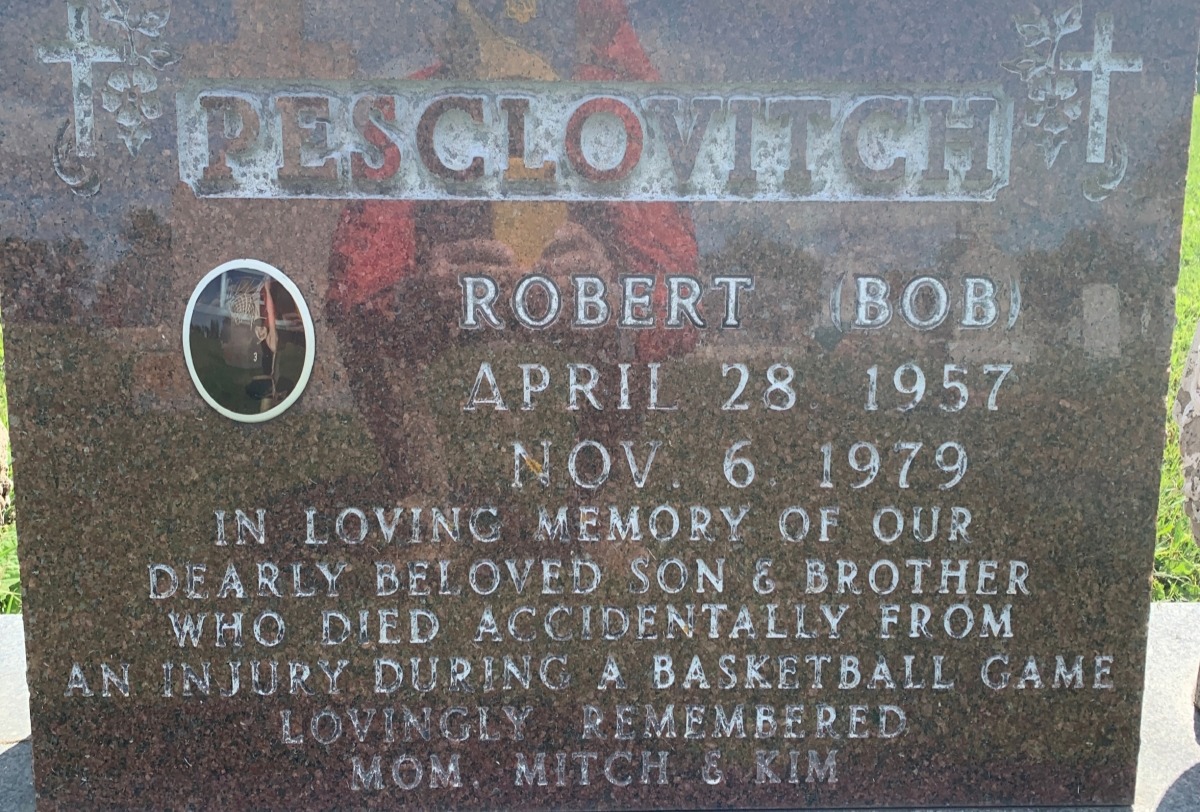
At 20, I was two years out of high school, diligently pursuing my university studies in Edmonton. One cold November evening, my high school basketball coach called to tell me that one of my former teammates, Bobby, had been killed in a basketball game, of all things, when he was driven head-first into a concrete wall behind the basket.
No question I would return to Winnipeg for the funeral, the first death in my life of someone that close to me, as my former teammates and I were (and remain) a tightly-knit group.
I distinctly remember how hard our coach and his wife cried as they lowered the casket into the ground. It wasn’t until I got into coaching myself many years later that I understood the depth of grief and loss that our coach would have felt as one of “his kids” was laid to rest.
But I don’t think I myself cried at any point during the service or the burial, despite feeling a combination of sadness and bewilderment (mixed with the joy of being with my former teammates again). It all felt surreal, as I don’t think I truly comprehended the stark finality of Bobby’s passing.
After all, I’d had no real experience with that.
Finally, a chance to grieve Bobby’s death properly
A few years ago, I re-visited Bobby’s grave, about 35 years after his death. His headstone includes a picture of him fake-dunking a basketball, with a look of pure joy on his young adult face.
That’s when I cried, and not just a little.
Maybe I cried because I thought about him, forever 22 and dunking that ball, while we who remain have aged. Or maybe because I thought of my own daughter, who was just coming into adulthood at the time. Perhaps it was because such sadness springs from the deeper understanding of mortality that only the passage of time can give us, or maybe all of these.
Bobby wasn’t on my periphery — he was a good friend and teammate who deserved for me to remember him well and grieve him completely when I was 20, even if I didn’t know exactly how to do that.
At 55, I was grateful to discover that I finally did, even though it was many years later. In fact, by that stage of life, I was already an old hand at death and all it encompassed.
Had a good chat with Bobby that day. Made me miss him more than ever.
Note that this is an abridged and updated part of a series originally published on this site in spring 2023
On dying & grief series
The Call of Home series
More memoir
The second generation: Life as a child of Ukrainian immigrants
Growing up working class, I wanted to be something else
Our house is not a “Very, very fine house”
Competition: Its unexpected value at every stage of life
Sacred space: This is where you connect with something bigger
Major Work: We were “Sputnik’s Children” – until “streaming” became a bad word
Fishing for the ‘Big One’? Forget it – any size catch will do
What you lose when you ignore ceremony and ritual
The value of reconnecting in our “last quarter”
Divorce 25 years on: Our daughter is still reaping the benefits
Letters: The wondrous time capsule I found on my bookcase
Navigating Friendship in My “Last Quarter”
Boating in retirement: The pitfalls of becoming “one” with the sea
The “Mongoose System” recipe for life: Take chances, make mistakes, and have fun
The truth about regret: You are what the results say you are
Cultural cross-currents: What I now know in moving to Canada’s only bilingual province
Happy ending? My family dysfunction would make For better TV
One uncomfortable truth my 18-year-old self needed to hear
Settling for less: How many of us end up doing what we truly love?
Generosity of spirit: The key ingredient to a successful marriage
November 1980: The day I struck a blow for Canada
Turning sixty-five has been a kick in the teeth in a way I never would have expected
Pachelbel, the CBC, and the liberal arts: A surprising connection