
And competition isn’t about winning at all costs
Competition sometimes gets a bad rap
When we think of competition, we sometimes picture a mega-mart undercutting prices to the point where a nearby mom-and-pop operation has to close up shop.
Or a basketball coach who somehow manages to recruit an academically dubious “ringer” or two every season to stay at the top of the standings (you’ll know this when the game program lists their post-secondary program as “general studies” — good grief).
Some argue that competition inherently breeds a “win at all costs” mentality, but it doesn’t have to. Healthy competition focuses on the process rather than the result, and on consistent improvement. When we pay more attention to getting better at something rather than on winning, we benefit in numerous ways — we challenge our minds, we find out what we’re capable of, and we enjoy whatever it is we’re doing that much more.
Sometimes, we even win, which is fun, too.
And this is true at every stage of life, even in our “last quarter.”
Rediscovering competition in curling (the sport, not the hair)
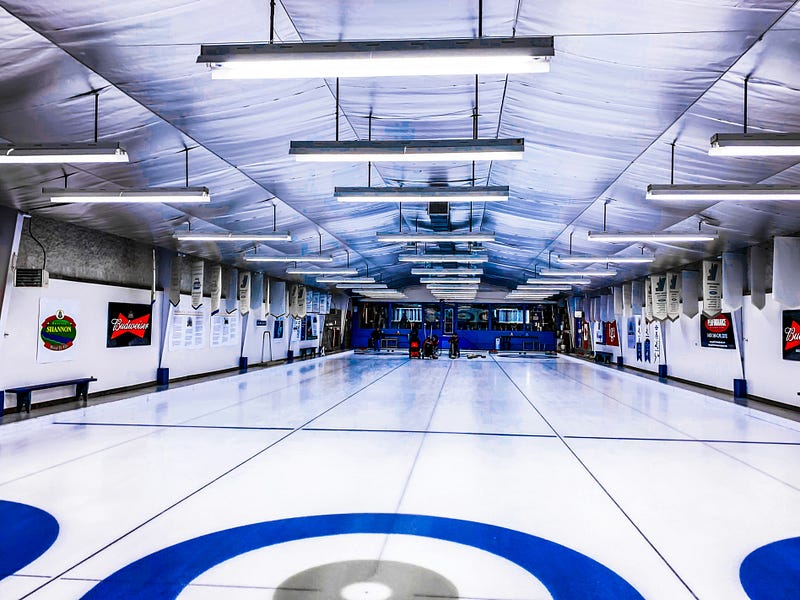
The idea for this piece arose from my recent foray — or rather “re-foray” — into curling. You know, the kind where players slide heavy granite stones down the ice and try to place more of their stones closer to the centre of the “house” at the other end than their opponents do.
Many years ago, when I was much younger, I used to curl the way the pros do: by delivering the stone while crouching and sliding on one foot. Now, I find “stick” curling to be more age-appropriate, as my “crouch-ability” is somewhat more limited.
The object of the game is still the same, but delivering the stone by pushing it from a standing position with a special stick comes with its own learning curve. You have to know how hard to throw the stone and how to make it curl the way you want. And I have loved every minute of that learning.
I also love the competition.
Competition at the heart of everything we did as kids
Competition in one form or another has been part of my life from very early on, as I found sports and games to be the glue that bound me to my friends and classmates. It gave us something to do all year, whether kicking or passing a football around in the park (or in our asphalt schoolyard — yikes), shooting a sponge puck in a modified game of shinny at the nearby hockey rink, or smashing a ping-pong ball in the basement.
We even drew concentric rings on an old table and played “world curling” games on it with small poker chips. But that was only when we hadn’t turned the table on its side to be a backstop as we played “hockey” on our knees on the thin basement carpet my parents had, using a ping-pong ball and broken ping-pong rackets.
No surprise that I’ve had both my knees replaced or that the rackets were broken, now that I think about it.
And you can bet your boots we kept score with everything, even though no one really cared who won. Mostly.
Oranized competition in my early years
As a young teen, I played organized hockey for a year and made the local six-man football team as a kicker. However, I had to give up the latter because my father made me attend “Ukrainian School” on Saturday mornings (an immigrant thing). That marked the end of my budding professional football career, I’m sure, although my abject lack of athletic ability may eventually have derailed that anyway.
We’ll never know for sure.
Then came high school, where I played basketball all three years. I didn’t see the court much during the games (actually, I saw it quite well from my reserved spot at the end of the bench), but I played as much pick-up ball as I could, both during and between seasons.
After high school, I played some senior men’s ball and continued playing pick-up on and off well into my 30s. I simply loved the game.
Then, it was back to hockey. We moved to a small rural Alberta community where the best way for me to make friends was to join a local rec hockey team, which I did. Got my competition fix that way for eight years, and made many lifelong friends besides.
When I was done with hockey, I got busy with some non-competitive activities for a while, including playing music with my daughter and some friends, and holding public office. Somewhere in there, I had my first real (albeit occasional) foray into curling, which I loved, but that was the extent of being able to slake my competitive thirst for some time.
Organized competition in more recent years
So it all sat until a chance meeting with an area basketball coach led to my coaching junior high boys for six years and mixed teams for three years at the Jeux francophones de l’Alberta (Francophone Games of Alberta) during that same period.
In coaching those young athletes, I cultivated my competitive spirit in a whole other way (while never once prioritizing winning over learning), and it resulted in six of the most fulfilling years of my life. Trusting the process, we won more than our fair share (including a gold medal at the Francophone Games one year), and all had a hell of a lot of fun besides.
Then, my wife and I moved across Canada in 2019. Between wanting to try some new activities as I headed into retirement and the oppressive presence of Covid, I shuffled participating in anything competitive onto the back burner for the better part of six years.
Until I discovered stick curling in time for this winter season.
The first day I showed up for unstructured practice prior to the start of the schedule, I quickly remembered how much I enjoy curling. But I also realized how much I’d been missing doing something involving competition in my free time.
Competition: Learning how to curl with a stick
Every sport has its particularities. With stick curling, you might think it’s just a matter of attaching the curling stick to the handle and sending the stone down the ice. This doesn’t even begin to cover it.
For instance, as one of the experienced people there — a provincial stick curling champion, no less — showed me, you obtain the stone’s desired speed (and therefore its chances of placing it where you want), not by pushing it harder, but by walking more quickly and releasing it naturally.
Huh. Never would have guessed that.
Then, the people I’m teamed up with showed me the intricacies of making the stone curl the way you want and how to aim correctly. Catching on to all of this didn’t take me long, as I’m a sponge for any type of coaching. All of a sudden, we’re scoring more points and winning our share of games.
Competition mostly against myself
Now, that doesn’t mean I’ve mastered the sport, as playing once or twice a week for a month isn’t going to accomplish that (and even then, no one plays perfectly all the time), but I’m already better at it than I was when I started. And, as the season continues, I’ll get better at it yet, which is precisely the point.
Sure, we keep score, and any given team would rather win than lose, but not a single person in this group would say they show up at the rink on Tuesday mornings to win games. We all show up to see how well we can play, and the score is simply a measuring stick in checking our own progress.
Everything about being there is fun — the people, the friendly competition (in two languages, no less), the focus on self-improvement, and the winning, if it happens. Note how far down that list I place the word “winning.”
I’m so grateful I discovered this opportunity to compete — against others, yes, but mostly against myself — at this stage of my life.
Healthy, balanced competition is good for us at any age
Some people think our “last quarter” should be nothing but rest. No stress, no challenge, no bother. Don’t get me wrong — there should be plenty of that, too, especially for the first year or so after leaving work.
And everyone will “do” retirement differently. But a retirement without physical or mental challenges will quickly atrophy both the body and the mind.
I want my retirement to include at least some competitive activities because competition encourages me to get better at something, whatever that may be. Physical competition, in particular, sharpens my mind, makes me pay attention to my body, and often creates opportunities to socialize.
But, social time or not, it’s best if I avoid the sweets people bring to the curling rink on Tuesdays. Being the person who packs on the most pounds during the curling season is definitely one competition I don’t want to win.
On dying & grief series
The Call of Home series
More memoir
The second generation: Life as a child of Ukrainian immigrants
Growing up working class, I wanted to be something else
Our house is not a “Very, very fine house”
Sacred space: This is where you connect with something bigger
Major Work: We were “Sputnik’s Children” – until “streaming” became a bad word
Fishing for the ‘Big One’? Forget it – any size catch will do
What you lose when you ignore ceremony and ritual
The value of reconnecting in our “last quarter”
Divorce 25 years on: Our daughter is still reaping the benefits
Letters: The wondrous time capsule I found on my bookcase
Navigating Friendship in My “Last Quarter”
Boating in retirement: The pitfalls of becoming “one” with the sea
The “Mongoose System” recipe for life: Take chances, make mistakes, and have fun
The truth about regret: You are what the results say you are
Cultural cross-currents: What I now know in moving to Canada’s only bilingual province
Happy ending? My family dysfunction would make For better TV
One uncomfortable truth my 18-year-old self needed to hear
Settling for less: How many of us end up doing what we truly love?
Generosity of spirit: The key ingredient to a successful marriage
November 1980: The day I struck a blow for Canada
Turning sixty-five has been a kick in the teeth in a way I never would have expected
Pachelbel, the CBC, and the liberal arts: A surprising connection